A8 Essential.
Designing an AI knowledge workspace for enterprise data powered by ModelMesh™
Overview
A8 Essential is an enterprise AI insights platform developed by Articul8. It helps organizations analyze their internal datasets and generate insights using autonomous AI systems. I led product design for the A8 Essential dashboard.
This enterprise workspace allows users to upload datasets, explore AI-generated insights, understand how these insights were created, and organize knowledge into structured threads. The platform utilizes ModelMesh™, an orchestration system that coordinates multiple AI models to analyze enterprise data and produce explainable insights. The main challenge was to make complex AI reasoning and knowledge graphs clear and trustworthy for enterprise users.
The Problem
Enterprise teams often work with thousands of documents, such as financial reports, research papers, internal knowledge bases, and operational data. Extracting meaningful insights is very challenging.
- Information fragmentation: Knowledge is scattered across systems.
- Slow workflows: Analysts spend hours reviewing information manually.
- Lack of visibility: Connections between entities are hard to uncover.
- Unstructured management: Difficult to turn insights into actionable outputs.
Product Vision
The vision was to create an AI-powered knowledge workspace where users can upload enterprise datasets, automatically extract relationships, ask questions in natural language, explore insights through knowledge graphs, and organize findings into a structured canvas.
"The goal was to design a system where AI enhances human reasoning, rather than replacing it."
System Thinking.
Designing A8 Essential required viewing the product as a connected AI knowledge system instead of just separate screens.
Enterprise Data
Users upload enterprise datasets.ModelMesh AI Orchestration
AI models evaluate and analyze data.Entity & Insight Extraction
Outputs organized into insight cards.Knowledge Threads
Insights automatically link via topics.Insight Workspace (Canvas)
Users explore insights interactively.Decision-ready Knowledge
My Role
- Defining the product UX strategy
- Designing AI interaction patterns
- Creating the product information architecture
- Designing the core dashboard workflows
- Collaborating with AI engineers and PMs
- Delivering designs ready for production via Locofy
Features & Workflow.
Connecting raw enterprise data to structured knowledge via four core capabilities: Data Ingestion, Generative Insights, Knowledge Graphs, and Synthesis Canvas.
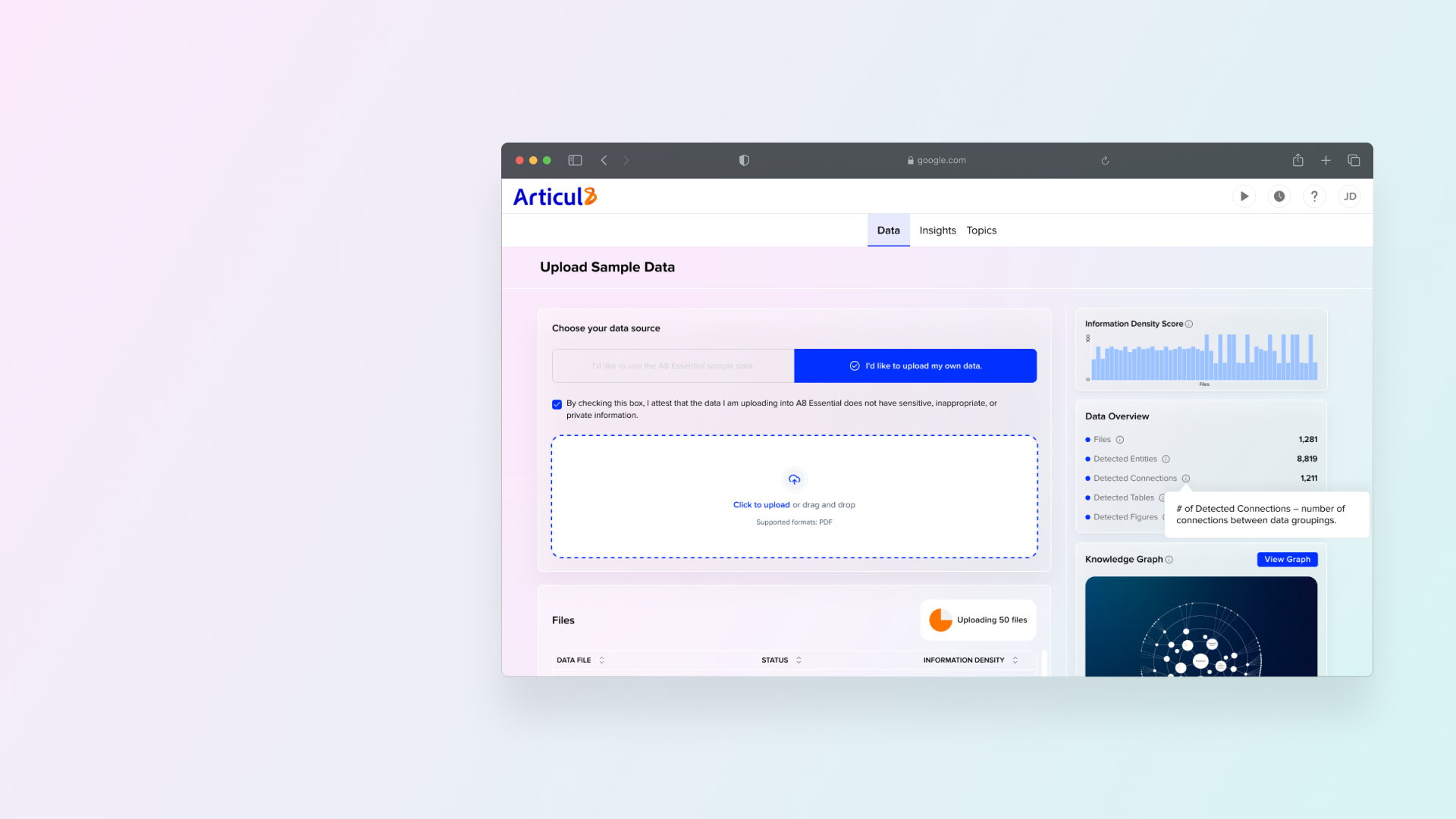
upload_file Data Ingestion & Transparency
Designed to reduce onboarding friction and support large datasets. Includes drag-and-drop, progress states, and error parsing. Once processed, the system immediately shows signal extraction metrics (entities, figures, relationships) to prove data richness before analysis begins.
account_tree Knowledge Graph Exploration
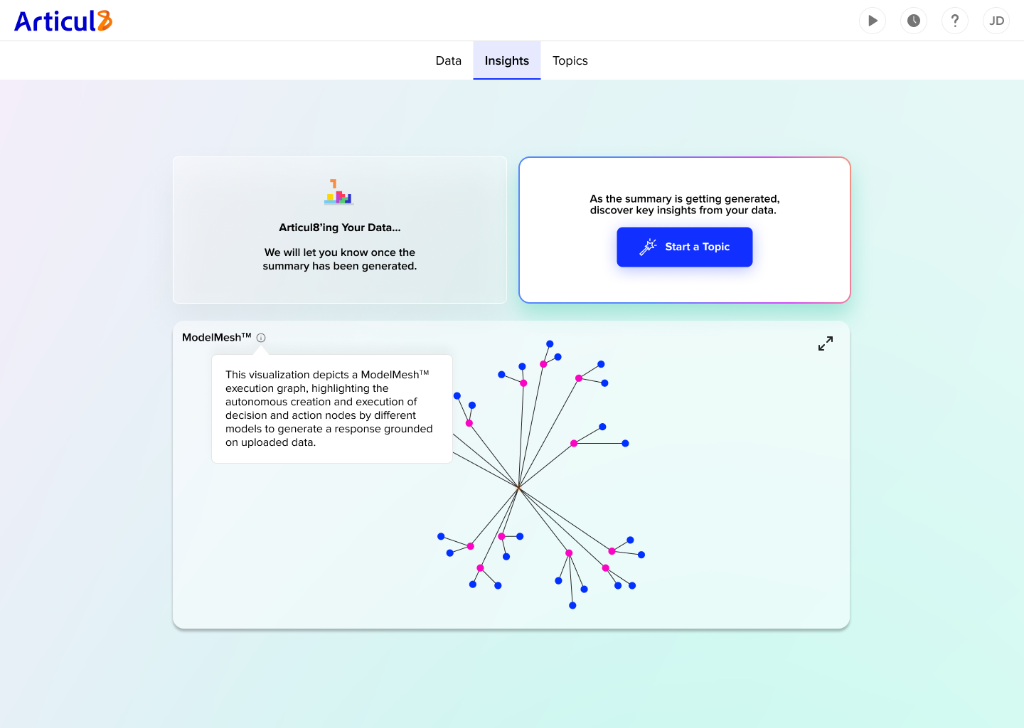
The ModelMesh engine automatically detects entities and semantic connections, visualizing them as an interactive graph. This allows users to identify clusters, explore relationships, and navigate complex knowledge networks spatially rather than just textually.
forum AI Insight Threads & Topic Management
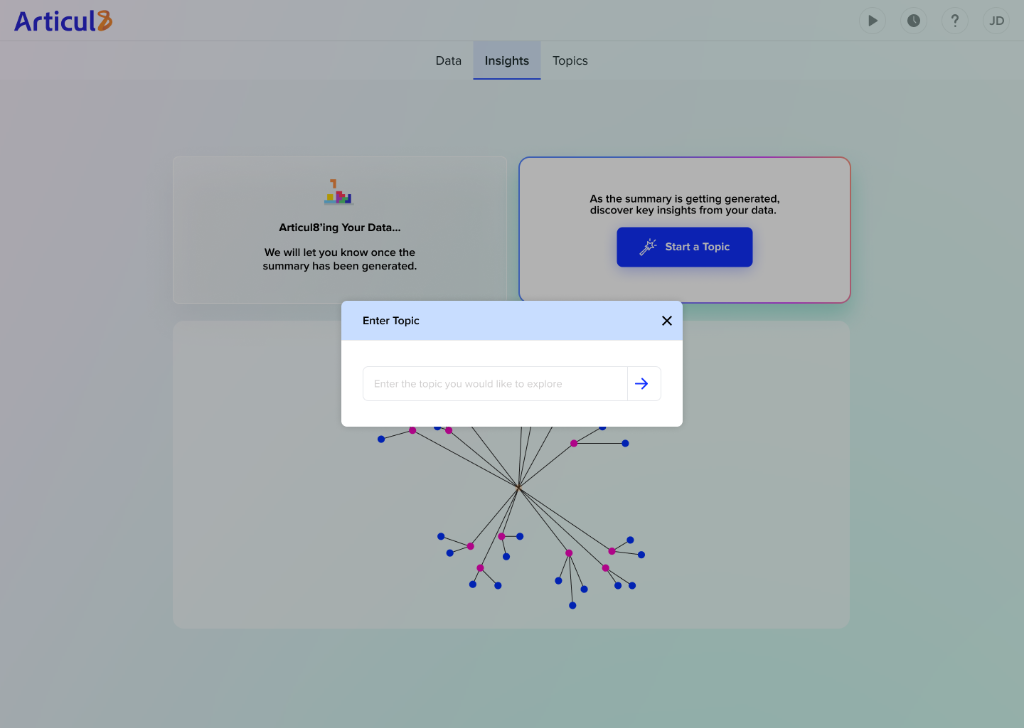
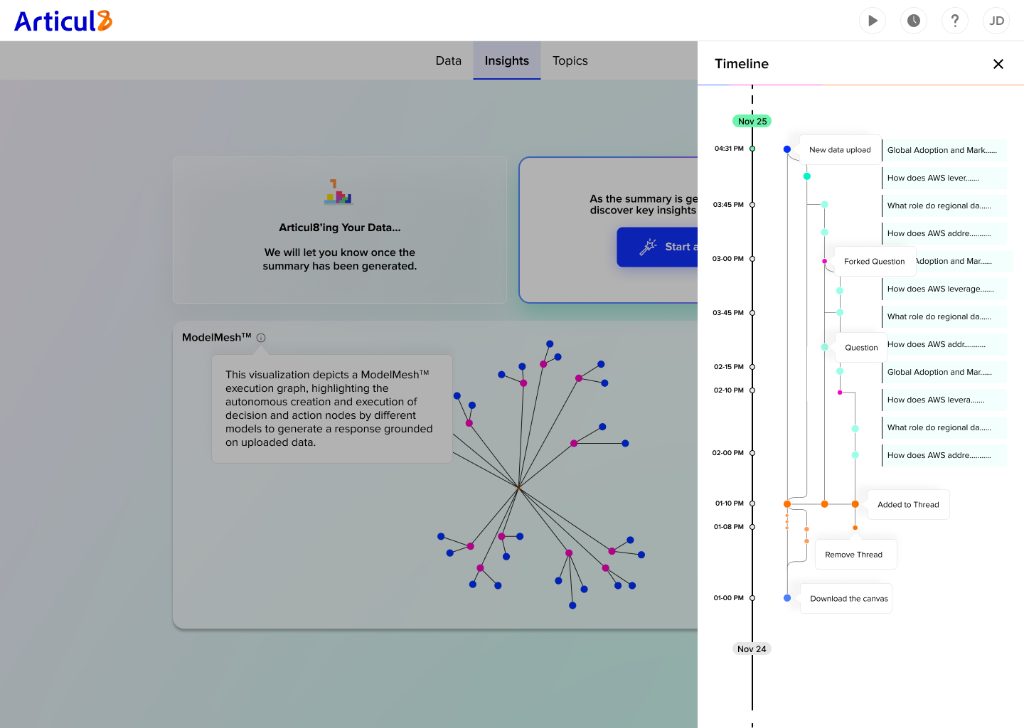
Insights are structured as interactive knowledge cards featuring AI answers, citation references, confidence scores, and contextual relationships. Users can organize these into "Topics" to track investigation paths and revisit insights over time.
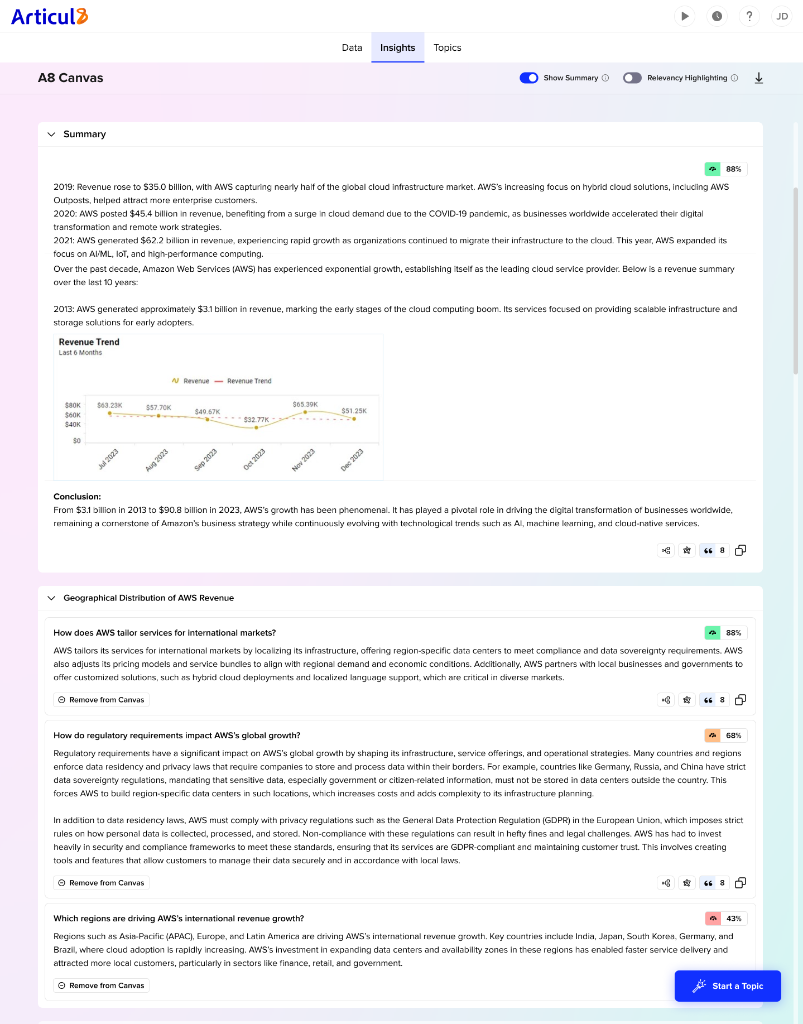
dashboard_customize The Insight Canvas
The main workspace for putting findings together. Users curate insight cards onto a canvas, strip out irrelevant data, create summaries, and construct narratives to export as final, decision-ready intelligence.
Interaction Design Patterns
- Progressive Disclosure: Expandable insight cards, contextual tooltips, and interactive graphs prevent cognitive overload.
- Transparency Signals: Interface includes confidence scores, citation references, and traceability indicators to build enterprise trust in AI.
- Cards over Chat: Results are generated as structured, movable cards rather than linear chat streams, turning AI into a tangible workspace object.
Impact & Outcomes.
Launched on October 15 following a 6-week design and development cycle.
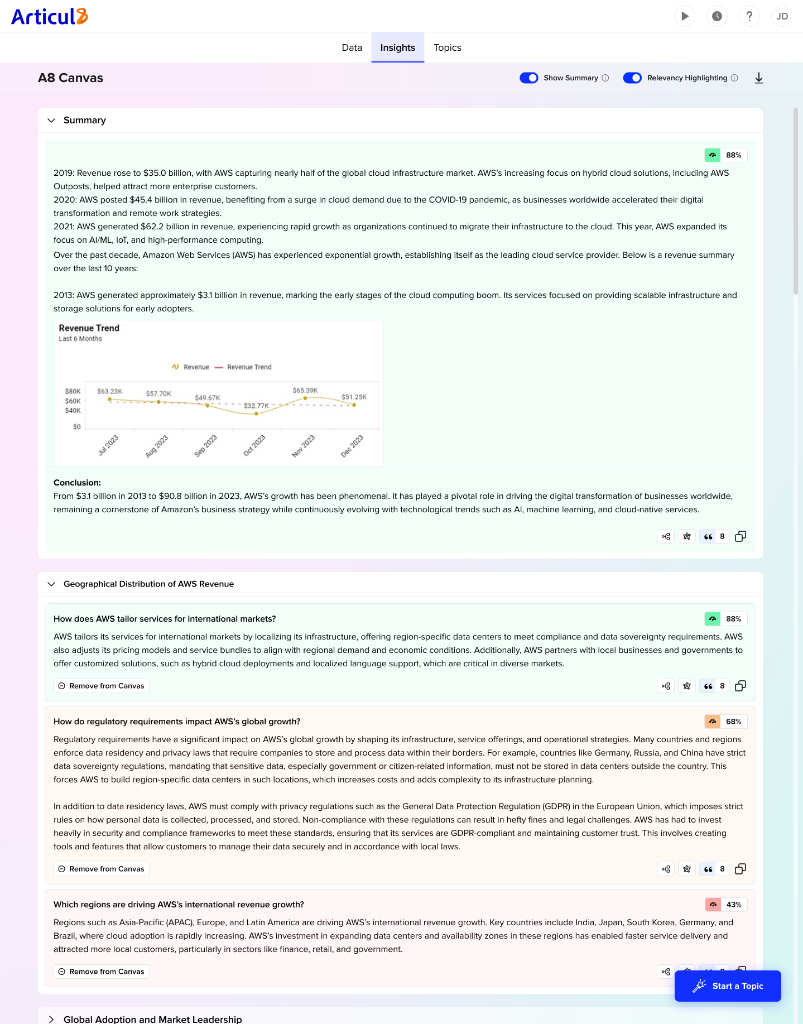
Behavior Change
Signals showed a massive shift towards active dataset exploration: +38% increase in Canvas usage, +41% increase in thread exploration, and +29% in follow-up question generation. Analysts stopped relying purely on manual reading.
Key Learnings
1. Explainability is essential. Users must grasp how AI generates results to
trust them.
2. Visualization enhances cognition. Knowledge graphs bridge the semantic gap
in deep datasets much better than text.
3. Insight workflows need structuring. AI answers alone aren’t enough—you need
to give the user tools (like the Canvas) to synthesize knowledge into reality.