Stripe Dispute Flow.
Redesigning Stripe's Merchant Dispute Flow
Improving how merchants respond to chargebacks and manage dispute evidence
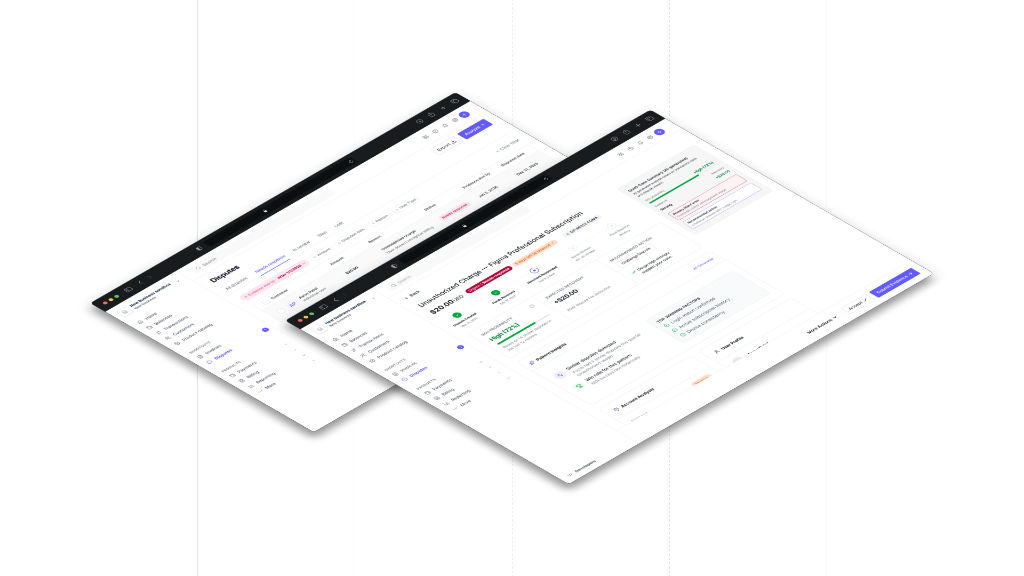
Overview
Chargebacks and payment disputes pose a significant challenge for online businesses. When customers dispute a transaction, merchants must quickly gather evidence and respond through the payment platform.
This case study looks at how the dispute management experience in Stripe could be redesigned to help merchants understand the status of disputes, respond more quickly, and increase their chances of winning.
The project aims to simplify the dispute workflow, reduce merchant confusion, and provide clearer guidance during the response process.
Problem & Users.
Payment disputes are complicated and time-sensitive. However, many merchants struggle with navigating dispute workflows.
The Problem
Payment disputes are complicated and time-sensitive. When a chargeback happens, merchants need to collect evidence, understand the reason for the dispute, and respond before strict deadlines. However, many merchants struggle with navigating dispute workflows.
Key issues observed
- Unclear dispute status: Merchants often find it hard to understand the current stage of a dispute and the actions required.
- Complex evidence submission: Submitting supporting documents can feel disjointed and hard to organize.
- Limited guidance: Merchants may not know which evidence types will increase their chances of winning a dispute.
- Time pressure: Responses must be submitted before strict deadlines, which raises stress and increases the chance of errors.
Primary User
Online Merchant
Merchants use payment platforms like Stripe to manage transactions and respond to disputes.
Characteristics:
- operate small to mid-size online businesses
- manage payments and disputes through dashboards
- often lack deep expertise in payment dispute processes
"Help me understand what happened and respond quickly with the right evidence."
Research & Insights.
Deconstructing the scanning pipeline to identify pain points.
To understand the dispute workflow, research included:
- studying Stripe documentation and support resources
- analyzing dispute management interfaces across payment platforms
- reviewing merchant experiences shared in forums and product reviews
Common patterns observed across payment platforms include: disputes triggered by issuing banks, strict response timelines, and evidence submission through dashboard interfaces.
Merchants need clearer status visibility
Understanding where a dispute stands in the process is essential for prioritizing actions.
Evidence requirements are confusing
Merchants often find it hard to determine which documents will strengthen their case.
Dispute workflows are fragmented
Important information, such as transaction details, dispute reasons, and evidence guidelines, may be spread out across multiple views.
Guided workflows reduce errors
Step-by-step processes help merchants respond confidently and provide complete evidence.
System Thinking & Architecture.
Dispute resolution is not a single action but a multi-stage financial workflow involving several parties. Designing the interface around this lifecycle helps merchants grasp the broader system context.
1. Customer Dispute
Customer files a dispute with their issuing bank.2. Bank Notification
Bank notifies the payment processor (Stripe).3. Merchant Alert
Merchant receives the dispute notification.4. Evidence Submission
Merchant collects and submits required evidence.5. Bank Review
Bank reviews the evidence submitted by the merchant.6. Dispute Outcome
Final dispute decision is issued (Won or Lost).Design Decisions & Trade-offs
-
Decision 1 — Guided workflow instead of a single form: Instead of
showing all evidence fields at once, the process was broken into smaller guided
steps.
Trade-off: More screens, but clearer guidance for merchants. -
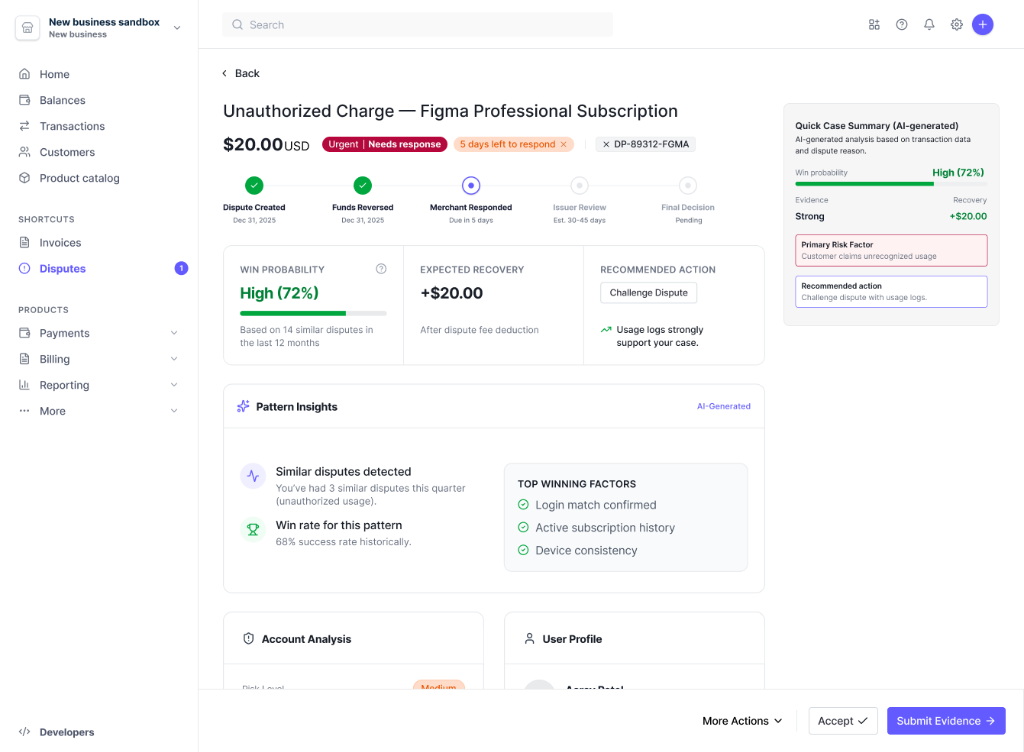
Decision 2 — Status visibility at every stage: The interface highlights
dispute status and deadlines to lessen uncertainty.
Trade-off: More UI elements increase visual density but improve clarity. -
Decision 3 — Evidence recommendations: The design suggests relevant
evidence types based on the dispute category.
Trade-off: Requires extra system intelligence but improves response quality.
Interface Design.
The redesigned interface emphasizes clarity and structured decision-making.
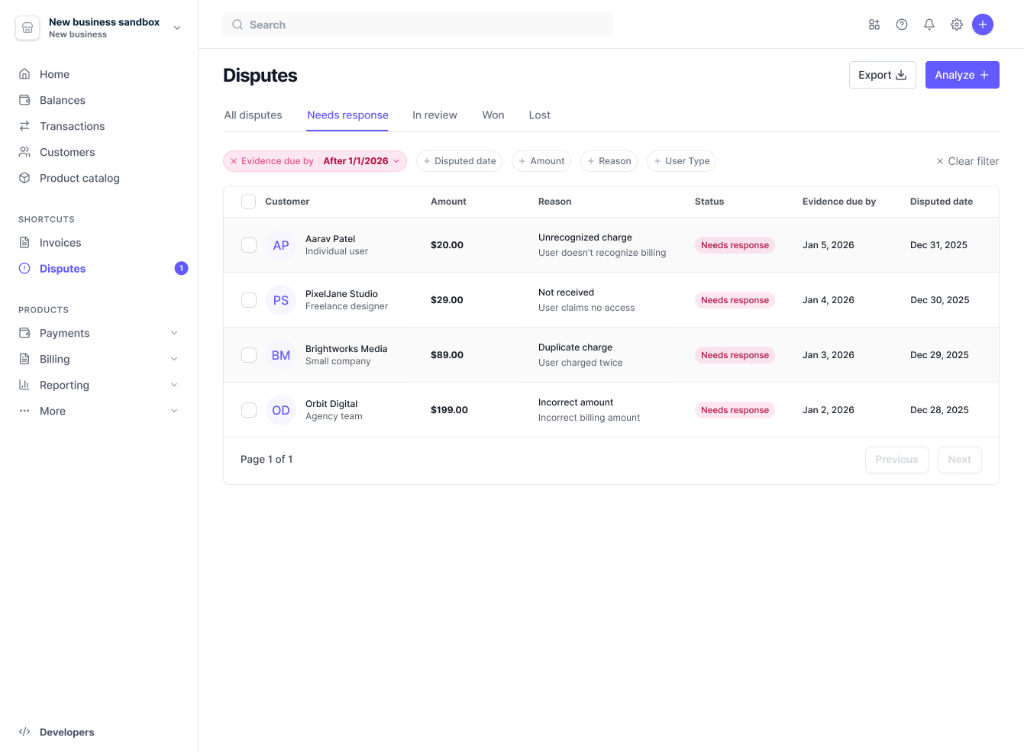
Dispute Dashboard
Provides an overview of active disputes with clear status indicators. Merchants can quickly see:
- dispute deadlines
- response status
- transaction details
Evidence Submission
A guided interface helps merchants upload documents and organize evidence logically.
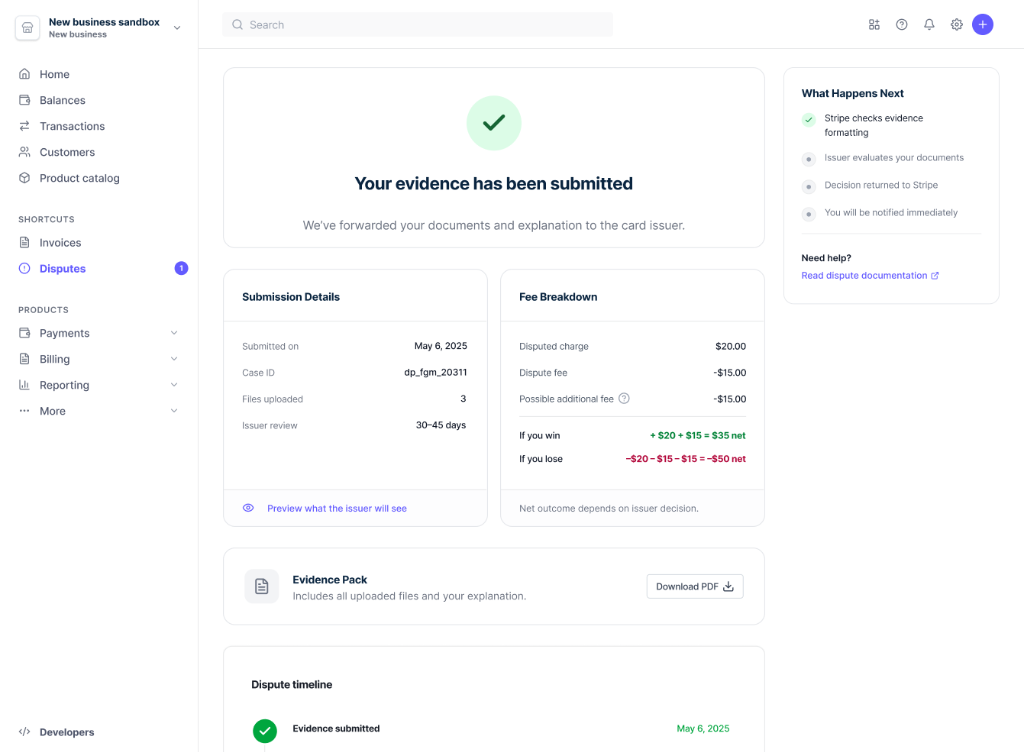
Dispute Response Review & Submission
Before submission, merchants can check that all required evidence has been included. Once submitted, merchants receive confirmation and a clear timeline for resolution.
Try the Interactive Prototype
A high-fidelity prototype was created in Figma to showcase the redesigned dispute workflow. The prototype simulates: dispute overview navigation, evidence submission flow, and dispute response confirmation. The interactive prototype allows users to see how the redesigned workflow simplifies dispute management.
Impact & Validation.
We validated the redesigned dispute flow with finance professionals who regularly handle chargebacks. The goal was to measure improvements in speed, clarity, and confidence during dispute submission.
What Changed User Behavior
- Users spent less time figuring out next steps
- Decision-making shifted from guesswork to guided actions
- Reduced back-and-forth during evidence submission
How This Was Measured
Tested with 6–8 finance professionals across tasks: submit dispute, review case, and upload evidence.
Metrics Tracked
- Time to complete task
- Error rate / missing fields
- Self-reported confidence